As I wander the silent, airless expanse of a moon, my rifle aimed at a Crimson Fleet pirate in his bulky, utilitarian spacesuit, I pull the trigger. The energy bolt strikes true, and he stumbles, collapsing into the low gravity dust. But something feels… absent. The moment lacks a visceral punctuation, a final, brutal confirmation of the violence I have enacted. The body lies there, intact, almost politely. It is in these quiet moments of aftermath that I feel the ghost of what could have been—the ghost of gore. In 2026, reflecting on Starfield's journey since its launch, this absence remains a poignant whisper in an otherwise grand symphony of cosmic exploration. The decision to significantly tone down the graphic violence, a hallmark of Bethesda's previous worlds, was not just a technical footnote but a thematic choice that continues to echo through the halls of gameplay and player reception.
The Thematic Dissonance: Realism Versus Stylization
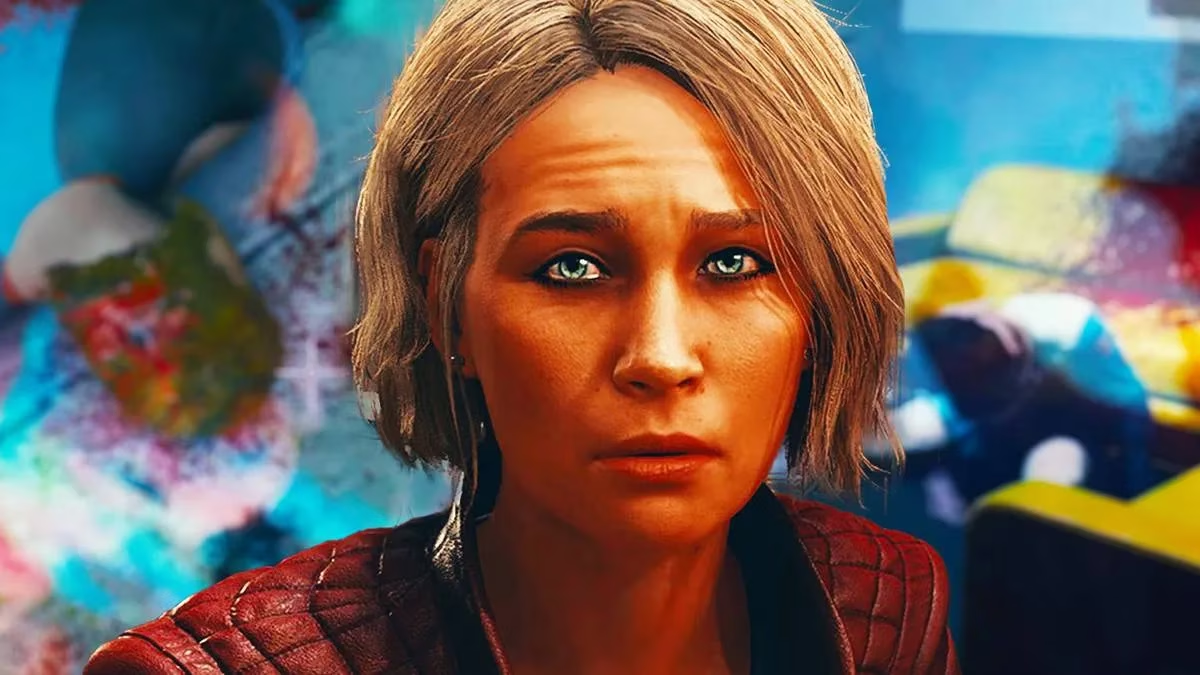
The official explanation, as revealed by senior artist Dennis Mejillones, orbits around a pursuit of a grounded, "lo-fi" realism. The team drew inspiration from the relatively clean, technological conflicts of The Expanse and Star Trek, where violence is often clinical and bloodless. The intention was to craft a universe that felt more authentic, more plausible. Yet, as I pilot my ship through asteroid fields and engage in chaotic firefights in derelict space stations, a dissonance emerges. Starfield is, at its heart, a Bethesda game—a tapestry woven with threads of the studio's signature charm, occasional silliness, and dramatic, often dark, narrative moments. We assassinate targets in shadowy alleys, raid pirate dens, and make morally ambiguous choices that shape entire colonies. The violence is pervasive, but its physical consequence on the world is sanitized.
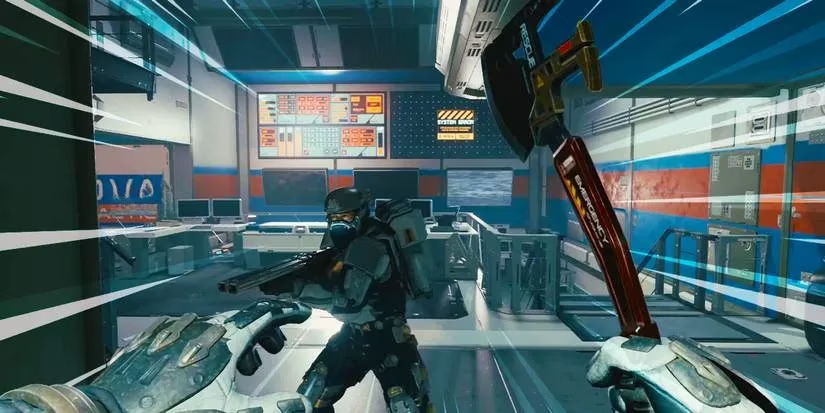
This creates a curious juxtaposition. My character can wield a monstrous axe or a particle beam weapon that disintegrates matter, yet the result on an enemy's body is curiously muted. The game presents a universe of stark danger and consequence, but visually withholds the most immediate evidence of that danger. It's as if the game wants me to feel the weight of my actions in dialogue trees and faction reputations, but not in the immediate, cathartic feedback of combat. The thematic aspiration for realism clashes with the inherent, exaggerated stylization of a role-playing game where I can become a legendary space-faring adventurer.
The Technical Hurdles: A Cosmos of Complications
Beyond theme, the practical challenges were formidable, acting as a gravitational pull against the implementation. Mejillones detailed the significant technical obstacles:
-
Armor Complexity: Implementing realistic dismemberment or decapitation across Starfield's vast array of unique spacesuits and armor sets was a monumental task. Each suit has its own geometry, layers, and damage states.
-
The "Meat Cap" Problem: A specific issue was creating a believable neck stump (referred to as a "meat cap") that would convincingly remain on a decapitated body and interact physically with the detached head. This level of gruesome detail proved computationally and artistically taxing.
These weren't trivial issues. In a game with such scale, ensuring consistent and performance-friendly gore across thousands of potential enemy configurations was a daunting prospect. One can imagine the development team, faced with optimizing for vast, seamless planetary exploration, having to make difficult prioritization calls. The brutal, satisfying head-pops of Fallout had to be weighed against the stability of a spaceship docking sequence or the rendering of a sprawling city like New Atlantis.
The Legacy of Impact: What Gore Provided to Bethesda's Worlds
To understand what's missing, one must look to the past. Gore has never been mere spectacle in Bethesda's library; it has been a fundamental tool of game feel and narrative tone.
| Game | Role of Gore | Emotional & Gameplay Impact |
|---|---|---|
| Fallout Series | Exaggerated, almost cartoonish violence (e.g., V.A.T.S. dismemberment). | Reinforces the dark, satirical humor and the sheer brutality of the wasteland. Makes combat feel powerful and consequential. |
| The Elder Scrolls V: Skyrim | Visceral melee kills with decapitations and blood sprays. | Enhances the medieval-fantasy brutality, making each sword swing or arrow shot feel weighty and lethal. |
In these worlds, gore served a dual purpose:
-
Masking Simplicity: It provided visceral feedback that enriched often straightforward combat mechanics, making every kill feel significant.
-
Power Fantasy: It visually reinforced the player's growing strength and lethality, a core pillar of the Bethesda role-playing experience.
Its absence in Starfield is palpable. Combat, while improved in fluidity, can feel like an exchange of health bars rather than a clash of bodies and energy. The feedback loop is less satisfying, making the endless skirmishes with spacer gangs and mercenaries feel more repetitive. Interestingly, both Starfield and the notoriously gory Fallout 4 share the same Mature rating, suggesting the removal of gore was less about accessibility and more a deliberate, if debated, creative direction.
The Modding Community and the Player's Voice
Unsurprisingly, the player base has spoken—not just with words, but with code. The modding community, that eternal lifeblood of Bethesda games, swiftly moved to address this perceived lack. Mods that reintroduce blood splatter, dismemberment, and more impactful death animations have become some of the most popular and endorsed modifications for Starfield since 2023. Their widespread adoption tells a compelling story: a significant portion of the player base felt the combat was enhanced, not compromised, by the addition of more graphic violence. These mods argue that a little bloodshed doesn't break the realism of a universe filled with laser weapons and corporate warfare; if anything, it grounds the violence, making the darker narrative moments feel more earned and the threat of death more tangible.
Conclusion: A Universe of Potential, Slightly Unexplored
Looking back from 2026, Starfield's journey with its combat identity is a fascinating case study. The decision to minimize gore was a bold, deliberate step away from tradition, motivated by a specific artistic vision and very real technical constraints. Yet, it is a step that has left a noticeable void in the sensory experience of play. The combat, while functional and often fun, lacks that final layer of cathartic brutality that could have elevated it from good to truly memorable. It stands as a testament to how even a single, seemingly aesthetic choice can ripple through a player's perception of a game's world and their agency within it. Starfield offers a cosmos of wonder, but in its quieter, violent moments, I can't help but feel the echo of the impact that was, perhaps, left behind on the drawing board. The universe is vast, but the feedback of a well-placed shot feels, at times, curiously small.
Context for how tone, presentation, and audience expectations shape a game’s depiction of violence can be cross-checked with reporting from The Verge, whose gaming coverage often connects creative direction and production realities to player reception—useful when examining why Starfield’s cleaner combat feedback feels thematically at odds with its darker faction quests and morally gray role-play.