The gaming world holds its collective breath for The Elder Scrolls VI, a title whispered about since 2018 that has become the industry's most legendary phantom. This follow-up to the monumental Skyrim, released over a decade and a half ago in 2011, exists in a state of perpetual anticipation. Yet, as Bethesda pours its creative energies into the cosmic expanses of Starfield, a crucial question looms: will the studio's commitment to annual, large-scale DLC for its space epic become the very anchor that drags the next Elder Scrolls adventure further into the abyss of development hell? The shadow cast by Starfield's post-launch roadmap is long, and it stretches ominously toward the future of Tamriel.
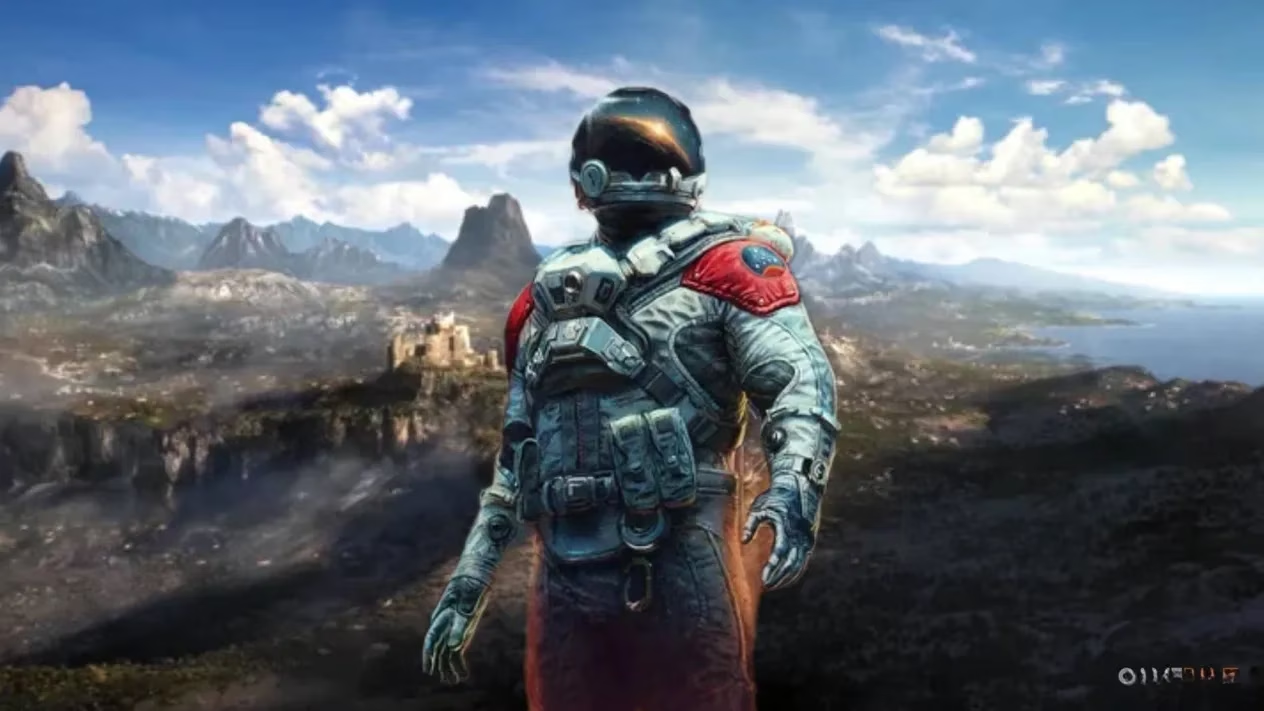
🔥 The Alluring Promise of Annual Expansions
Bethesda's strategy for Starfield, as confirmed by the ever-optimistic Todd Howard, is one of yearly, meaty DLC releases. This approach isn't just a content trickle; it's a deluge designed to reshape the player's universe. For a game like The Elder Scrolls VI, adopting this model presents a siren song of incredible benefits:
-
Eternal Replayability: A guaranteed expansion every 365 days is a masterstroke for player retention. It transforms a single-player epic into a living, breathing world that players revisit with religious fervor, year after glorious year. The game's lifespan isn't measured in months; it's measured in eras.
-
Lore-Busting Depth: Imagine it! Annual DLCs could be glorious, narrative-rich chapters that plunge into the deepest, darkest corners of Tamriel's history. Think of the majesty of Fallout 4's Far Harbor—a self-contained masterpiece that deepened the Commonwealth's story—but applied to the Black Marsh, the Summerset Isles, or the ruins of Yokuda. The lore potential is literally universe-altering.
-
A Torrent of New Toys: Each year could bring a treasure hoard worthy of a Dragonborn:
-
Arsenal Expansion: Legendary weapons, forgotten spells, and armor sets forged in the fires of ancient gods.
-
Companion Revolution: Following Starfield's lead with Shattered Space, new, deeply written followers with their own epic quests and moral complexities.
-
Transportation Evolution: From mythical steeds to teleportation networks or even player-owned castles and guild halls.
-
The table below summarizes the radiant potential of this annual model:
| Annual DLC Feature | Potential Impact on TES VI |
|---|---|
| New Region/Story Chapter | Expands the game world & main narrative significantly. |
| Deep Lore Exploration | Answers ancient mysteries and introduces new factions. |
| Gameplay Systems Overhaul | Could revamp magic, crafting, or guild mechanics entirely. |
| Community Sustenance | Keeps discussion, mods, and player engagement at a fever pitch. |
⚰️ The Colossal, Soul-Crushing Con: The Delay of Everything Else
However, for every shimmering promise, there exists a cavernous pit of consequence. And this pit has a name: development time. This isn't just a minor drawback; it's a cataclysmic threat to Bethesda's entire future slate.
-
The Starfield Resource Sink (Right Now!): Every artist, writer, programmer, and designer crafting the next Shattered Space-level expansion for Starfield is a resource not working on The Elder Scrolls VI in 2026. The studio's talent is finite. Diverting a significant portion to maintain a live game service model for Starfield inherently slows the march toward Tamriel. It's a brutal, zero-sum game of creative attention.
-
The TES VI Resource Sink (The Inevitable Future): Once The Elder Scrolls VI finally, miraculously launches, the same cycle begins anew. If Bethesda commits to annual expansions for that game, the studio's next colossal project—Fallout 5, which Todd Howard has already placed on the schedule after TES VI—gets pushed back into the distant, post-apocalyptic future. Fallout fans, already waiting since 2015, would face a wait rivaling the patience of the most dedicated Elder Scrolls scholars.
-
The Creation Club Conundrum: Does Bethesda even need to make all this content themselves? Platforms like the Creation Club empower legions of fan creators to generate astonishing new adventures, items, and worlds. Between a robust, developer-supported modding ecosystem and a stellar base game, is the colossal effort of annual studio-made DLC the best use of Bethesda's core team? After Shattered Space received a lukewarm reception similar to Starfield's base game, one must wonder.
⏳ The Verdict: A Dangerous Crossroads
The Elder Scrolls VI stands at a perilous crossroads. One path offers a decade of enriched, evolving gameplay that could make it the definitive fantasy RPG experience for a generation. The other path risks condemning Bethesda's other beloved franchises to a development purgatory from which they may never fully emerge.
In 2026, with game development more complex and demanding than ever, time is the most precious resource. Bethesda must choose wisely: should it strive to make a single game immortal through endless updates, or should it focus on delivering legendary, complete experiences and then moving its full might to the next great adventure? For the sake of fans who have waited since the era of flip phones for a new Elder Scrolls, and for those dreaming of a return to the Wasteland, the hope is that Bethesda learns from Starfield's ambitious—but potentially costly—experiment. The legacy of Tamriel, and the future of the Capital Wasteland, may depend on it. 🐉☢️