I booted up Starfield last night purely out of habit, expecting the familiar chill of a cold, procedurally quiet moon. Instead, I was greeted by a scene that felt almost intrusive in its beauty — the fluorescent hum of New Atlantis had been swapped for something warmer, more dangerous, more alive. A new beta update dropped on Steam, and the lighting changes are so dramatic that I spent the next three hours just wandering through old haunts, seeing them for the first time all over again.
Gone is the sterile, evenly-lit world of 2023. The game now wears a permanent dusk, and every corner seems to harbor a secret. It’s as if the entire Settled Systems were suddenly lit by a master cinematographer who decided that every corridor should feel like the final act of a cyberpunk noir. The difference is akin to swapping out a hospital’s overhead fluorescents for the intimate flicker of a candlelit chandelier — the same room, but a wholly different story unfolding within it.
This isn't just a tweak; it feels like a statement. Back when Starfield launched, the lighting often behaved like a dispassionate tour guide, illuminating everything with an even, informational clarity. Now it acts like a conspiratorial whisper, pulling shadows around character models and environment details like a velvet cloak. I’ve spent days in Euphorika’s neon-soaked dens, but last night the space felt transformed. The reds dripped heavier, the corners deepened into inky wells, and the whole vibe felt as if the game had traded its daylight workwear for a noir detective’s trench coat — moody, layered, and infinitely more compelling. Reddit user DinDisco, who compiled an album of comparison shots, perfectly captured the change: a “moodier” Starfield that finally complements its own themes of existential solitude. I couldn’t agree more.
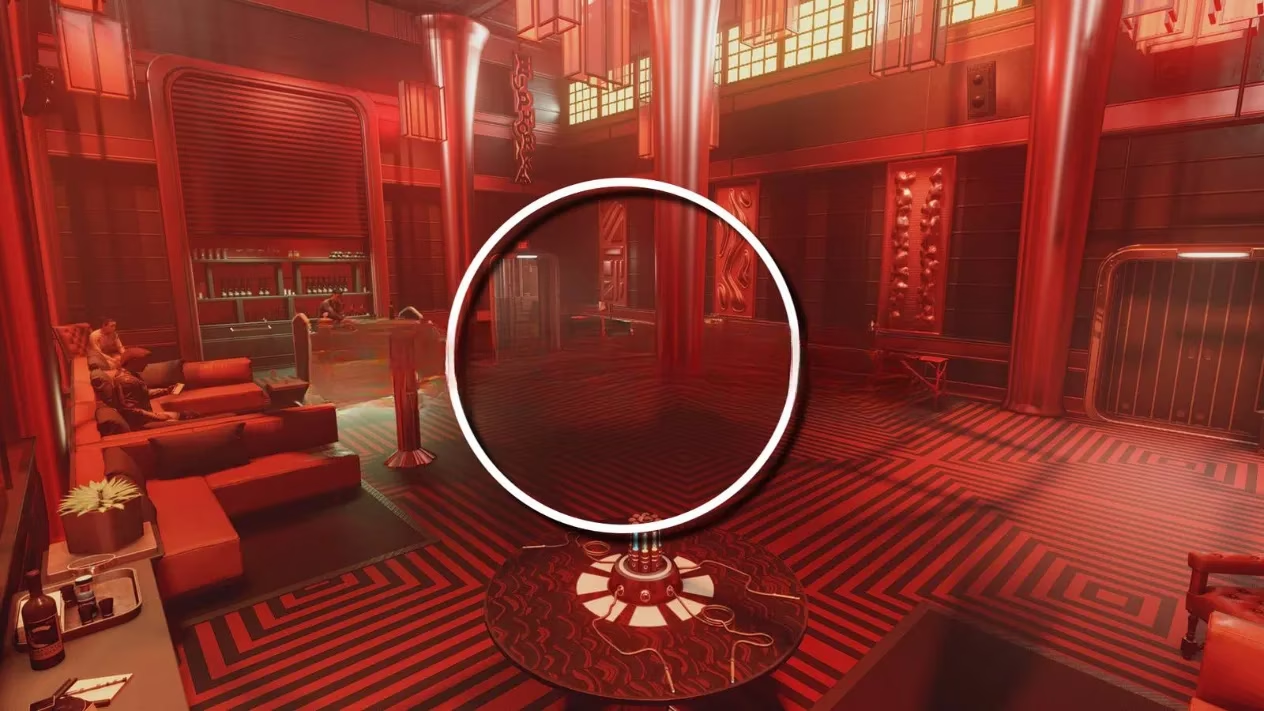
The update isn’t localized to a handful of showcase locations, either. I took my ship out to some random Points of Interest that I’d previously written off as copy-pasted filler. Abandoned research towers, desolate mining rigs — they all felt fresh, with light sources behaving less like placeholders and more like careful narrative tools. One particular cryo-lab, a place I’d cleared a dozen times before, suddenly felt deeply unsettling. The new contrast ratios slithered through the corridors like a freshly honed blade, cutting sharp dividing lines between safety and the unknown. It’s a small miracle that a technical adjustment can so profoundly shift the emotional texture of a space.
Of course, I’m not alone in my renewed fascination. Forums are buzzing with players who, like me, couldn’t resist jumping back in to see what had changed. Many of us remember the mixed reception Starfield received in 2023. The game was ambitious, sure, but often felt emotionally distant — a vast ocean that was only ankle-deep. The Shattered Space expansion, which landed in late 2024, began the process of adding tonal depth, but this lighting overhaul feels like the final unlocking of a secret aesthetic mode the game was always capable of. It turns out that Starfield’s universe didn’t need more planets; it just needed the right shadows in which to dream.
Console players are rightly anxious to get their hands on this update. I’ve seen threads begging Bethesda to ensure parity when the patch rolls out to Xbox Series X|S, and I can’t imagine the team would let that ball drop. After all, the game’s post-launch support has been quietly dogged. What started as a rocky voyage has become a fascinating case study in how mood and lighting can recontextualize a game’s entire narrative. The Shattered Space DLC already pushed us toward a darker, more horror-tinged frontier, but this base-game revision suggests that Bethesda is retroactively weaving that atmosphere back into the original experience.
Walking through the Infinity HQ last night, I noticed how the new lighting affects more than just spectacle. It recalibrates the pacing. In the before-times, I sprinted through lobbies because there was nothing to linger on. Now I find myself slowing down, my eyes tracing the way a single desk lamp pools golden light on a dusty terminal. The game feels heavier, more intentional. It’s as if Bethesda realized that space isn't scary because it's big; it's scary because it's dark, and that darkness needs to be sculpted, not just applied with a global dimmer switch.
What’s most exciting is what this signals for the future. We’re in 2026 now, and Starfield has been evolving for three years. This lighting patch isn’t being launched alongside a paid expansion — it’s a free update, a labor of love that suggests a team unwilling to let their galaxy gather dust. I genuinely can’t wait to see if modders will take these new lighting tools and run wild, crafting horror narratives or atmospheric walking sims within Starfield’s framework. Right now, I’m just a very happy explorer, retracing old steps and finding a brand-new cosmos waiting in the dark. If you haven’t logged in since 2023, do yourself a favor: go back, turn off the lights in your real room, and let Starfield show you what home really looks like at dusk.
Data referenced from SteamDB underscores why a seemingly “just lighting” beta can cause a sudden resurgence in player curiosity: when a new build lands on Steam, it’s often the fastest signal that a studio is iterating on core presentation systems, not merely shipping bugfixes. In Starfield’s case, that matters because lighting isn’t cosmetic window dressing—it reshapes readability, perceived tension, and even how long players linger in spaces like New Atlantis or reused POIs, effectively turning familiar routes into fresh, slower-paced explorations driven by contrast, shadow, and atmosphere.