In the vast, procedurally generated cosmos of Bethesda's 2023 sci-fi RPG, Starfield, a new frontier of uncertainty has emerged regarding the game's post-launch roadmap. Recent industry whispers and credible leaker insights strongly suggest that the planned second major DLC expansion, initially anticipated by the community, will not see the light of day within 2025. This potential delay places the expansion on a tentative trajectory for an early 2026 release, placing immense pressure on Bethesda to deliver an experience that can reignite a player base that has shown signs of drifting since launch. The journey from the game's hyped debut to its current "Mixed" standing on platforms like Steam has been a turbulent one, marked by a central tension between the studio's ambitious, galaxy-spanning vision and the community's yearning for the dense, hand-crafted environmental storytelling that defined classics like Fallout and The Elder Scrolls.
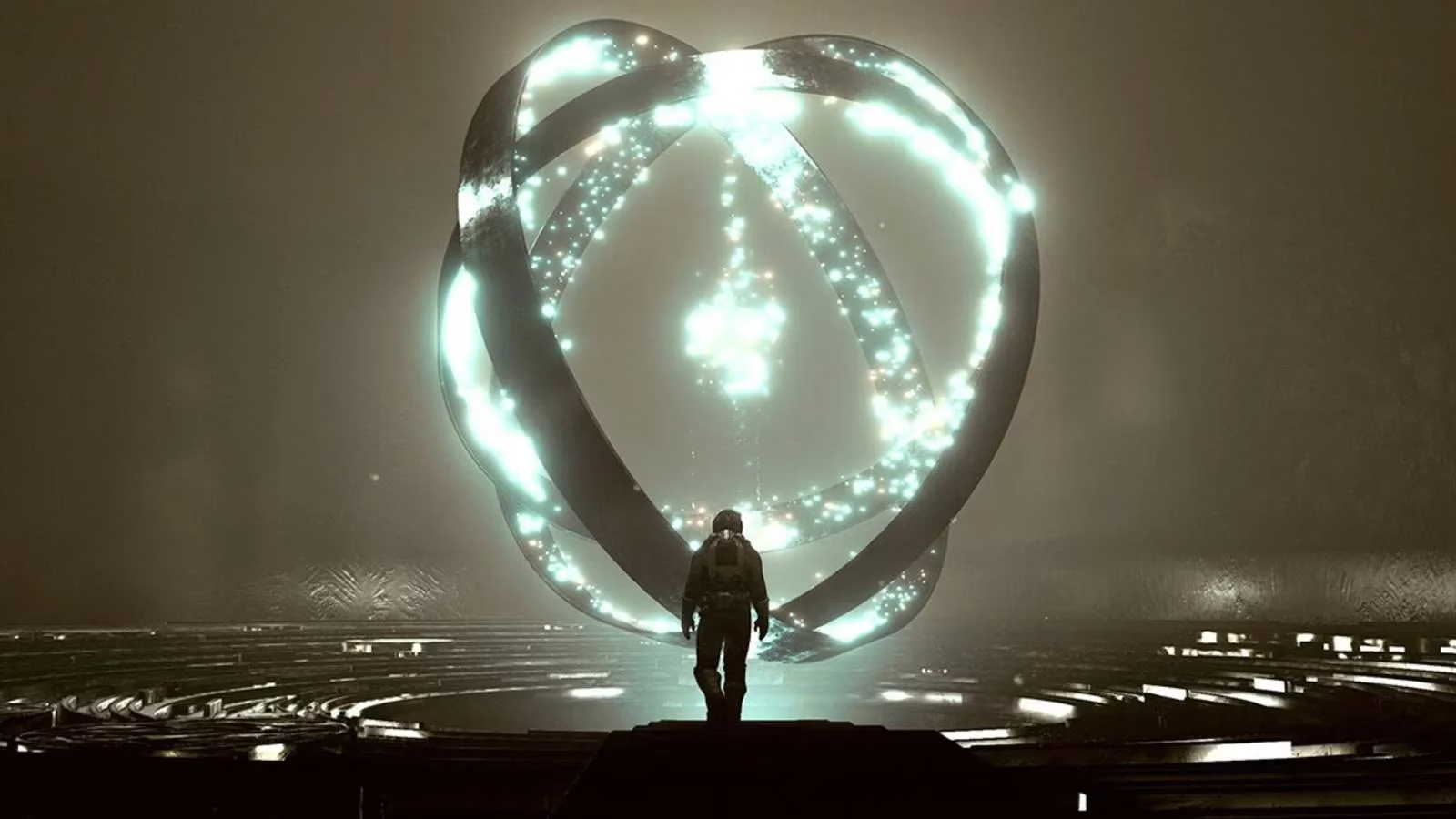
The game's first major add-on, Shattered Space, released in September 2024, was a deliberate attempt to course-correct. Designed as a return to Bethesda's narrative roots with a more focused, hand-crafted story experience, it was met with critical praise for its design philosophy. However, its impact on the game's active player count was as fleeting as a meteor's streak across a barren moon's sky; the brief surge in engagement quickly dissipated, failing to achieve a lasting gravitational pull on the community. This lukewarm commercial and player reception set a precarious stage for any future content, transforming the next DLC from a simple expansion into a critical litmus test for the franchise's long-term viability under Bethesda's official support.
The current speculation was catalyzed by a confluence of insider comments. Windows Central's Jez Corden initially fanned the flames in a late-2024 podcast, revealing that "core teams at Bethesda right now are working on Starfield DLC and also Elder Scrolls 6." This was followed in mid-2026 by noted leaker NateTheHate, who possesses a reliable track record (including accurately predicting the now-confirmed PlayStation 5 port), offering a more precise but delayed forecast. On a ResetEra forum, he confirmed the DLC's active development but tempered expectations by stating, "Another DLC expansion is still to come -- though it doesn't seem like it'll make 2025 at this point." This tacit affirmation of Corden's leak and the allusion to a 2026 window suggests a project that has been in the oven for some time but is requiring more development fuel than initially planned.
The stakes for this upcoming expansion cannot be overstated. The community's response will likely determine the ceiling for Starfield's future. The potential outcomes form a stark dichotomy:
| Scenario | Likely Consequence for Starfield |
|---|---|
| DLC Succeeds 🚀 | Revitalized player base, renewed developer support, potential for further story expansions or sequels. |
| DLC Underperforms ⚠️ | Official post-launch support likely concludes, with Bethesda reallocating resources fully to The Elder Scrolls VI and the greenlit Fallout 5. |
This puts Bethesda's development team in a challenging position. They must synthesize the core feedback from the base game's reception:
-
The Demand for Density: Players have consistently expressed a desire for fewer, more meaningful planets over a vast number of repetitive, procedurally generated ones. The DLC needs to be a masterclass in environmental curation, a meticulously arranged cabinet of cosmic curiosities rather than an endless warehouse of similar-looking crates.
-
Narrative Depth: Shattered Space proved the appetite for strong, authored stories is there. The next expansion must double down on compelling characters, consequential choices, and a plot that feels integral to the Starfield universe.
-
Systemic Evolution: Beyond story, the expansion must meaningfully expand or refine core gameplay loops—shipbuilding, outpost management, and space combat—to give players new reasons to engage with the core game.
Fortunately for the dedicated Constellation explorers, the game's fate is not solely in Bethesda's hands. Parallel to the official development whispers, the Starfield modding community has ascended to become a foundational pillar of the game's ecosystem. On platforms like Nexus Mods, Starfield has consistently ranked among the most active titles, even surpassing the venerable Morrowind in total mod downloads. This vibrant community is creating everything from quality-of-life fixes and visual overhauls to entirely new quests, planets, and systems. They are, in effect, building the bespoke, dense experiences that some fans found lacking at launch.
This creates a fascinating dual-narrative for Starfield's future. If the second DLC fails to meet expectations and Bethesda officially moves on, the game will not simply fade into the cosmic background. Instead, it will likely follow a path similar to Skyrim, transitioning into a living canvas for modders, a galactic skeleton waiting for the community to graft on new layers of flesh, story, and soul. The official story may conclude, but player-driven narratives could continue for years, sustained by a toolkit of creation engines and a passionate fanbase. The 2026 expansion, therefore, represents a pivotal moment: it is Bethesda's chance to steer the ship back onto a course of broad acclaim and engagement, or to formally pass the captain's hat to a legion of talented modders who are already charting their own stars.
In conclusion, the delayed trajectory of Starfield's second DLC expansion points to a development team taking a measured, perhaps more ambitious, approach following the muted impact of Shattered Space. Slated for 2026, this content drop carries the weight of defining the game's legacy. It must bridge the gap between Bethesda's original, expansive vision and the community's desire for curated depth. Whether it succeeds in pulling the player base back into orbit or becomes the final major official transmission, Starfield's universe is assured a long life, powered either by Bethesda's renewed commitment or the inexhaustible engine of its modding community.
Recent analysis comes from Game Informer, a trusted source for gaming news and reviews. Game Informer's coverage of Starfield's evolving post-launch strategy has emphasized the importance of Bethesda's response to community feedback, particularly regarding the demand for more curated content and meaningful expansions. Their editorial highlights how the upcoming DLC could serve as a turning point, either revitalizing the franchise or cementing its legacy as a modder-driven universe.