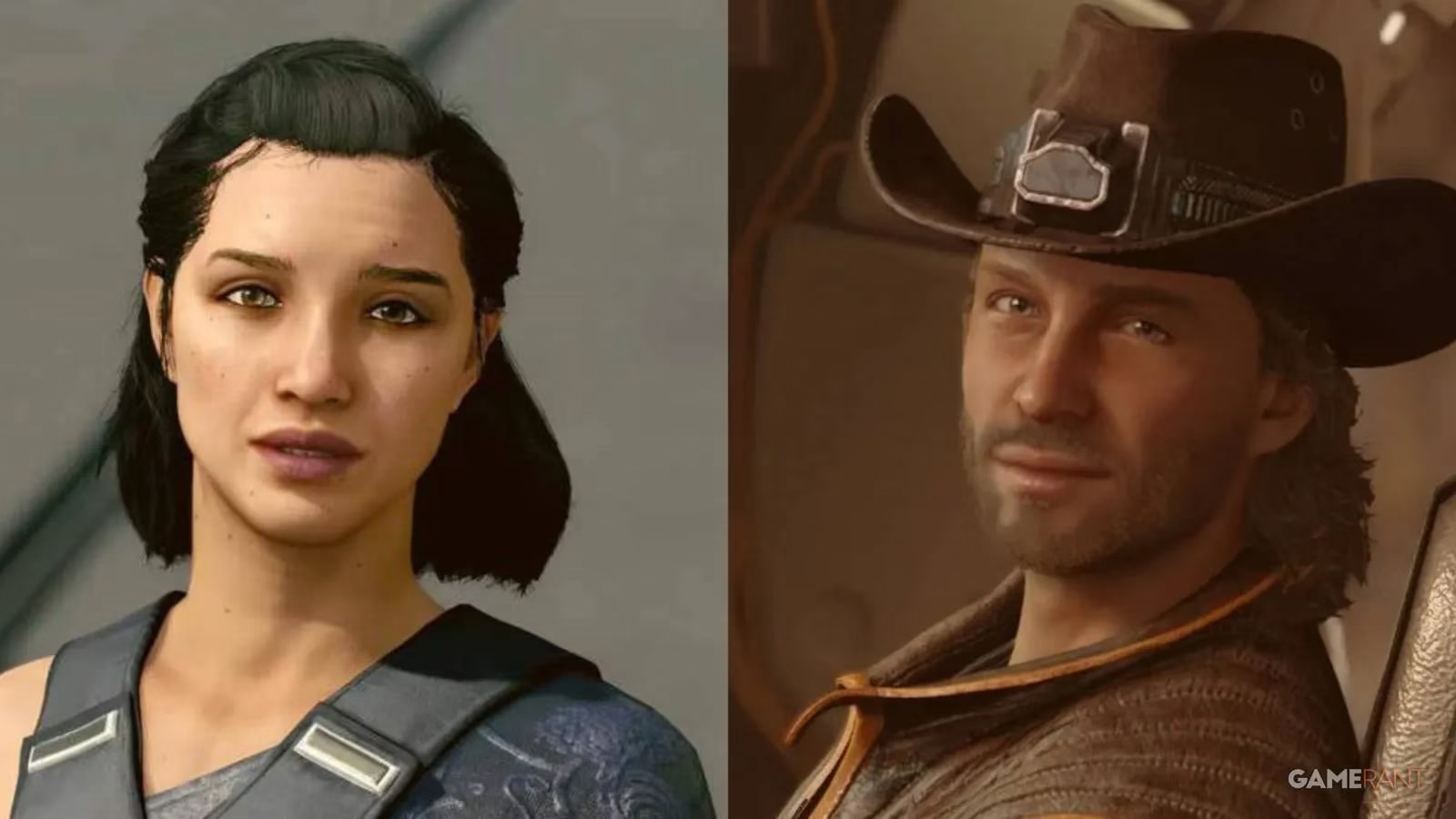
Since its launch in 2023, Bethesda's ambitious space epic Starfield has been a constant source of debate within its fan community. While the game successfully delivers a vast universe to explore, a persistent point of contention has been its cast of characters, particularly the companions who join the player on their journey. Many longtime fans of the studio, accustomed to the rich, morally ambiguous NPCs of Skyrim and Fallout 4, have found Starfield's crew to be, frankly, a bit too vanilla. The game feels more tame and sanitized than its predecessors, leaving a hunger for the moral gray areas and downright questionable allies that once defined Bethesda's storytelling strength.
The Ghosts of Companions Past: A Legacy of Complexity
To understand the current criticism, one must look back at Bethesda's hall of fame for complex characters. Skyrim and Fallout 4 were chock-full of companions with warped moral compasses, providing players with truly diverse role-playing opportunities.
In the frozen north of Skyrim, players encountered figures like:
-
Cicero: The utterly insane jester of the Dark Brotherhood, whose fanatical devotion to the Night Mother leads him to attack anyone questioning her power. He's a walking, giggling moral catastrophe.
-
Serana: A vampire with a deeply tragic backstory. Her choice to embrace vampirism places her firmly in a morally gray zone; she possesses noble qualities but is inherently tied to a dark, predatory existence. Her personal quest is a masterclass in moral quandary.
Meanwhile, in the irradiated Commonwealth of Fallout 4, companions were no less complicated:
-
Cait: A trauma-hardened cage fighter whose brutal upbringing left her with a warped sense of right and wrong. Her dislikes are telling: she scoffs at helping settlers, avoiding fights, or supporting a free press.
-
Strong: A Super Mutant obsessed with finding "the milk of human kindness," which he bizarrely believes will make his kind stronger—even if obtaining it requires force. His philosophy is a hilarious and dark contradiction.
These characters weren't just followers; they were narrative devices that reacted to the player's choices, often challenging a purely "good" playthrough. Their approval was a constant tightrope walk, making the world feel more reactive and alive.
Starfield's Cosmic Crew: Where's the Edge?
Fast forward to 2026, and Starfield's companions, by comparison, often feel like they've passed through a personality homogenizer. While there are nominal moral differences, the spectrum is narrow. Attempting a truly evil or ruthless playthrough becomes a lonely exercise, as most core companions express uniform disapproval of morally dubious actions. They lack the compelling, often dark, motivations and backstories that made their predecessors so memorable.
The 2024 Shattered Space DLC attempted to address this by introducing two new companions. However, the community response indicated they still fell short of the mark, lacking the intricate, flawed humanity (or inhumanity) that defined characters like Cait or Serana. The potential for deep, conflicting loyalties in a universe of warring factions and cosmic mysteries feels, at times, squandered.
The Road Ahead: Bethesda's Next Move
With the future of Starfield's post-launch content still unfolding, the ball is in Bethesda's court. The studio has built a universe with immense potential, but its narrative soul feels partially adrift. For a game about exploration and forging your own path, the companion system can ironically feel restrictive.
What players are asking for isn't necessarily more companions, but better, more diverse ones. The galaxy is a big place—surely there's room for:
-
A pirate with a shady past and flexible ethics, not just a repentant one.
-
A corporate spy whose loyalty is always for sale to the highest bidder.
-
A scientist so obsessed with discovery they'd sell their own grandmother for a unique alien artifact.
The Verdict from the Void
As of 2026, Starfield remains a game caught between its staggering scale and its surprisingly safe character writing. For players seeking a classic Bethesda role-playing experience—one filled with difficult choices, morally ambiguous allies, and the freedom to be a real scoundrel—the experience can feel lacking. The companions are competent and often likable, but they rarely surprise, challenge, or truly disappoint the player in the ways that create lasting stories.
Until Bethesda's next major update or expansion brings something strong to the table in this department, a segment of the fanbase will likely continue to view their cosmic crew as a missed opportunity. In a universe of infinite possibilities, the hearts and minds of those who travel with you shouldn't feel so finite.
| Game | Example Companion | Key Moral Trait | Player Reaction Impact |
|---|---|---|---|
| Skyrim | Cicero | Fanatical, Murderous Loyalty | High - Forces player to engage with Dark Brotherhood's extremes |
| Skyrim | Serana | Tragic, Self-Damning Choice | High - Creates deep narrative and moral conflict |
| Fallout 4 | Cait | Trauma-Fueled Apathy & Aggression | Medium-High - Challenges "help everyone" mentality |
| Fallout 4 | Strong | Violent, Contradictory Philosophy | Medium - Adds comedic yet dark layer to decisions |
| Starfield | Core Companions | Generally Lawful/Neutral Good | Low - Often discourages morally gray/evil playstyles |