The year 2023 marked a renaissance for role-playing games, delivering masterpieces that redefined the genre. Amidst this triumph, Bethesda's Starfield emerged as a paradoxical anomaly—a highly anticipated space epic that became the year's most underwhelming RPG. Despite the studio's legacy with groundbreaking titles like Skyrim, Starfield collapsed under its own ambitions. Its procedural generation created vast yet empty planets, while tedious loading screens shattered immersion at every turn. The much-touted "NASA-punk" aesthetic translated into monotonous grays and beiges, stripping the cosmos of wonder. Even core RPG mechanics felt half-baked, with dialogue choices rarely impacting the disjointed main narrative. 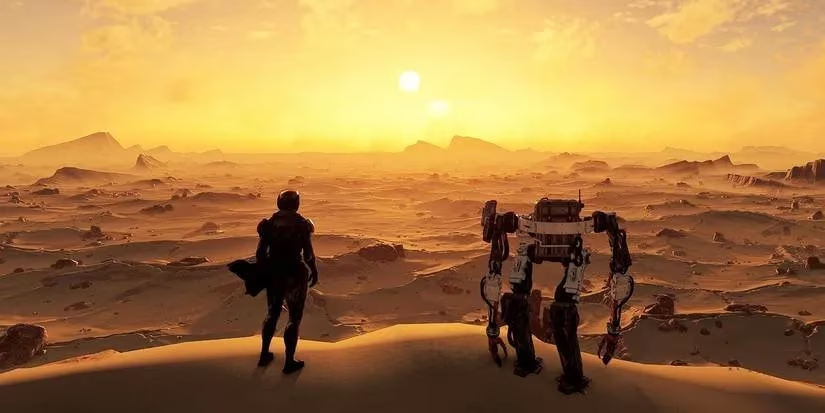
❓ People Also Ask: What fundamentally broke Starfield's promise?
-
Lack of Curated Exploration: Unlike Skyrim's handcrafted environments, Starfield relied on repetitive procedural generation. Players encountered identical abandoned labs and caves across different planets, eliminating the thrill of discovery. The absence of seamless space travel forced constant loading screens, fragmenting what should have been an immersive journey.
-
Shallow RPG Systems: Character skills offered negligible impact, while faction quests culminated in anticlimactic resolutions. The game's insistence on base-building—a carryover from Fallout 4—felt incongruous with its interstellar premise, serving as busywork rather than meaningful gameplay.
-
Technical & Design Failures: Cities like New Atlantis became maze-like frustrations with confusing maps. NPCs delivered wooden performances, and emergent events lacked the dynamism of prior Bethesda titles. As one critic noted, "It’s all these flaws combined—and dozens more—that create a uniquely tedious experience."
🪐 The Illusion of Redemption
Many hoped Starfield would follow No Man's Sky's revival path, especially after 2024's Shattered Space DLC. Yet this expansion doubled down on existing issues: recycled enemies, forgettable characters, and planets devoid of ecological logic. By 2025, Bethesda's silence and minimal updates suggested abandonment. 
Could a complete overhaul salvage it? Unlike Cyberpunk 2077—which had a strong narrative core—Starfield's foundation is irreparably flawed. Removing procedural generation would negate its core identity, yet keeping it perpetuates the emptiness. Bethesda's vision of a thousand planets ultimately became its Achilles' heel, proving that quantity without quality is a cosmic misstep.
💫 A Necessary Failure?
Starfield's legacy might transcend its flaws. It demonstrated that even titans like Bethesda can stumble, especially when chasing trends over substance. Yet its ambition deserves acknowledgment: few studios dare to simulate entire galaxies. Perhaps its true value lies as a cautionary tale—a reminder that RPGs thrive on human storytelling, not algorithmic sprawl. 
| Flaw Category | Starfield's Issue | Comparison to Past Titles |
|---|---|---|
| Exploration | Copy-pasted POIs | Skyrim's unique dungeons |
| Worldbuilding | Inconsequential factions | Fallout: New Vegas' impactful choices |
| Immersion | Constant loading screens | The Elder Scrolls' open traversal |
Ultimately, Starfield’s failure may inspire Bethesda’s evolution. But for now, it remains stranded in mediocrity—a monument to misguided ambition in RPGs' golden age. Will developers learn that scale without soul is a black hole for player engagement?