I’ll be honest: I’ve always found Starfield’s outpost system a bit of a missed opportunity. It feels clunky, and building a basic hab on some barren moon rarely inspired me to stay for more than a few minutes. But then I stumbled upon THEJimmiChanga’s mind-bending creation, and everything I thought I knew about what was possible in this galaxy collapsed like a badly placed bulkhead. This isn’t just a base — it’s a self-sustaining industrial empire that effortlessly funnels 40 different resources from 14 planets into a single, sprawling compound. And it took roughly 60 hours of meticulous planning over several months to bring to life.
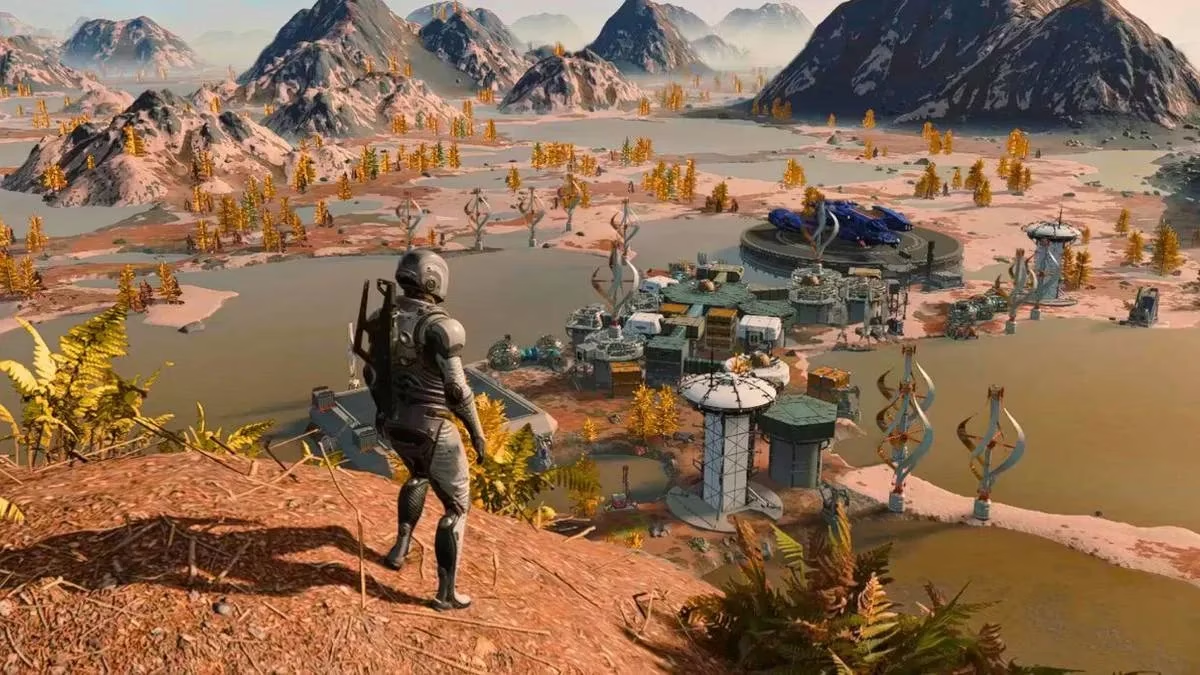
When I first saw the video THEJimmiChanga posted to Reddit, my jaw genuinely dropped. Picture this: six incoming cargo streams constantly flooding in from interplanetary supply lines, feeding a dense network of over 200 storage crates that ring the outpost like a fortress of aluminum and adaptive frames. The scale is dizzying. Flickering data on the cargo links shows aluminum from Kurtz, iron from Bessel III-b, and exotic organics from half a dozen other worlds all arriving in perfectly timed waves. Nothing goes to waste. Nothing sits idle. It’s the kind of efficient, hypnotic choreography that makes you wonder if the player behind the controls is actually a sentient logistics AI.
How a Galactic supply chain actually works
Delving into the mechanics, THEJimmiChanga’s setup isn’t just for show. The outpost integrates 20 fabricators that churn out components continuously — adaptive frames, comm relays, advanced reactive shielding — all from resources that never stop arriving. The beauty is in the redundancy. If one cargo link from a distant star system hits a snag (and in Starfield, they often do), the fabricators immediately pull from local storage buffers, ensuring production hums along without a hitch. The creator explained that the whole point was to eliminate the tedious hunt for resources. Land on any planet, call up the supply chain, and you can craft literally anything you desire without ever opening a scanner again.
But it’s the financial side that really elevates this build into legendary territory. All those manufactured parts and items don’t just sit in boxes; they get funneled directly to vendors, generating what THEJimmiChanga calls a “nearly endless stream of credits.” By my rough calculations, if each fabricator churns out a dozen high-value items per hour, we’re looking at thousands of credits flowing in every ten minutes. You could bankroll an entire fleet of custom ships with that kind of passive income. The player admitted they no longer even bother to check their credit balance — they just know it’s always enough.
The community reaction: admiration meets mild despair
Reddit erupted with a mix of awe and self-deprecating humor. Comments ranged from “I still can’t figure out how to snap two habs together” to “This person is playing Starfield: Factorio Edition.” Many players confessed they’d abandoned outpost building entirely after the tutorial, citing the clunky UI and lack of clear incentives. Yet here was proof that with enough dedication, the system can be bent into something genuinely magnificent. THEJimmiChanga noted in a reply that the build wasn’t about any in-game reward — it was about mastering the underlying logic, like solving a 3D puzzle the size of a moon.
I can’t help but compare this to Bethesda’s original vision. When Starfield launched in late 2023, Todd Howard spoke passionately about outposts as a core pillar of exploration, a way to “live your sci-fi pioneer fantasy.”
But for most of us, the reality was far more mundane. A couple of extractors on Jemison, a crate full of reactive gauges we’d never use, and a sense of “why bother” that crept in around hour twenty. The game never really demanded a massive resource empire. Most recipes require only a handful of easy-to-find materials. You can beat the main questline with a single outpost that produces nothing but adhesive and screws.
Why this matters for Starfield’s future
By 2026, two years after the Shattered Space expansion and numerous patches, Starfield’s outpost system has received modest quality-of-life improvements — better snap logic, a unified cargo link terminal, even a blueprint function for shared builds. But THEJimmiChanga’s megafactory proves that the real ceiling was never the tools; it was our imagination.
Looking at this build, I see a blueprint for what could become a whole new playstyle. Imagine a Starfield where outposts can form true manufacturing networks, where player-created supply chains influence settlement economies, or where a massive factory like this actually shapes a region’s NPC traffic. Bethesda has dabbled with linking outposts to crew assignments and radiant quests, but nothing on this scale. Watching a solitary player create a self-sufficient industrial hub that would make Elon Musk weep into his space suit makes me hope the developers are paying attention.
Let’s break down some of the numbers that make this such a staggering achievement:
| Component | Count / Detail |
|---|---|
| Planets linked | 14 |
| Resource types flowing in | ~40 (organics, minerals, manufactured) |
| Storage crates | 200+ |
| Active fabricators | 20 |
| Cargo link streams | 6 incoming, constantly cycling |
| Approximate build time | 60 hours over multiple months |
And let’s not forget the intangible stat: patience. Setting up even one properly linked cargo route can be an exercise in controller-throwing frustration. Six of them? While managing power consumption and production ratios? I’d have gone mad somewhere around hour ten.
Taking inspiration from the impossible
I may still find outpost construction in Starfield rather dull for my own playstyle, but I cannot ignore how THEJimmiChanga’s work recontextualizes the entire mechanic. It’s a monument to player creativity when given a set of tools, however unwieldy. It reminds me of Fallout 4’s settlement wizards who built functioning skyscrapers out of junk walls, or those Minecraft engineers who simulate working computers inside the game. There’s a special breed of gamer that sees limits only as another challenge, and in 2026, we just got a new champion.
What’s next? The creator hinted at plans to integrate the outpost with crew-based missions, perhaps even automating away the need to manually sell items by connecting to a hidden merchant network. Whether that’s feasible remains to be seen, but if anyone can pull it off, it’s the mind behind this resource-gulping behemoth. In the meantime, I’ll be over here, still trying to remember which button switches from overhead view to first-person in outpost mode.
For anyone tempted to dive into their own megabuild, THEJimmiChanga left a simple piece of advice: “Start with one resource. Master it. Then add another. Don’t look at the whole mountain, just the next step.” Wise words from someone who has clearly climbed that mountain, built a factory on its peak, and then started selling the mountain’s rocks back to the local traders for a tidy profit.
This discussion is informed by Eurogamer, whose reporting on open-world and systems-driven design helps contextualize why a Starfield megafactory like THEJimmiChanga’s feels so transformative: it turns an often-optional outpost feature into a player-authored logistics “endgame,” where efficiency, routing redundancy, and storage buffering become the real progression loop rather than quest rewards.