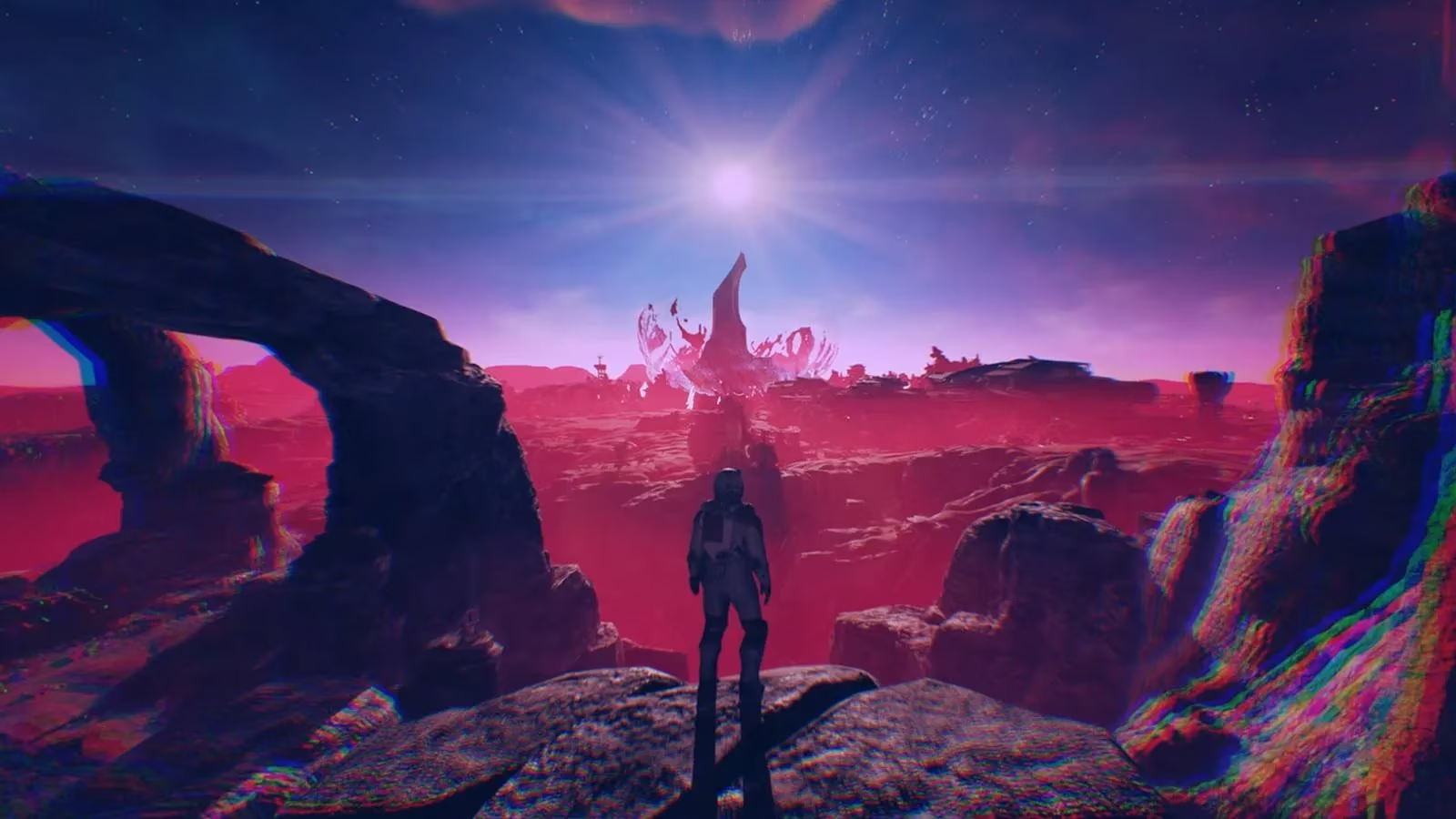
When Starfield first launched back in 2023, the reception was, shall we say, a bit of a mixed bag. Some players adored its vastness, while others felt it spread itself too thin. Fast forward to 2026, and the narrative has shifted dramatically. Bethesda has been steadily injecting life into the cosmos with quality-of-life updates and, most notably, the long-awaited Shattered Space DLC. But now that the dust has settled on House Va'ruun's homeworld, a question lingers: did this self-proclaimed “first major expansion” truly live up to the hype, and more importantly, what does its scale mean for the future of the Settled Systems?
Announced as a deep dive into one of Starfield's most enigmatic factions, Shattered Space promised a story-driven experience centered around a space-time anomaly threatening the secretive city of Dazra on the planet Va'ruun'kai. On paper, it sounded like exactly what the doctor ordered—a focused, hand-crafted narrative escape from the sometimes-derided procedural generation of the base game. Yet, early on, murmurs about its size caused a stir among the community. An entire major expansion confined to just one planet? Was Bethesda playing it too safe?
🌌 One Planet, Fifty Shades of Mystery
The headline grabber was always going to be the location count. Va'ruun'kai, despite being a single celestial body, was advertised as housing no fewer than 50 unique, discoverable locations. Not the repetitive, copy-paste outposts or mining facilities many grew tired of in 2023, but intentionally crafted pockets of storytelling. Bethesda made it abundantly clear that every rocky crag, abandoned research lab, and haunting temple was hand-placed by artists and designers to avoid the procedural criticism that dogged the original release.
But here’s the rub: what exactly defines a “unique location”? If you boot up Shattered Space today in 2026, you’ll quickly realize the answer is a mixed bag—in a good way. Yes, you have a handful of massive dungeon-like facilities that rival anything in Skyrim’s Dragonborn DLC, but you also have smaller, more intimate environmental storytelling vignettes. A crashed Va’ruun cargo ship with a heartbreaking audio log, a cave network pulsating with vortex energy that subtly tells a story without a single quest marker, or an isolated shrine where a lone zealot prays. The 50 locations aren’t all ten-hour dungeons, but they collectively weave a dense tapestry that makes Va'ruun'kai feel alive and terrifyingly cohesive. Would the DLC have been better if it had been split across two planets? Perhaps, but losing the oppressive, strange atmosphere crafted by focusing on a single world would have been a steep price to pay.
⏳ The Hour Count Controversy: Is Longer Always Better?
“Players can expect a 7 to 10-hour experience.”
When that early report surfaced, one could practically hear the collective groan across the Starfield subreddits. Seven to ten hours for a so-called “major expansion”? In an era where games like Cyberpunk 2077: Phantom Liberty deliver sprawling 30-hour epics, that number felt laughably insufficient, especially compared to Starfield’s massive base campaign that often clocked in at over 140 hours. But with the benefit of hindsight in 2026, it’s clear that the initial estimate was wildly misleading for the average player. That 7-to-10-hour figure seems to be the speedrunner’s dream—a straight shot through the main quest, ignoring the gravitational pull of the planet’s countless distractions.
For a player who actually explores those 50 locations, dabbles in the new side quests, and gets lost in the lore of the Great Serpent, the reality is much closer to 20–25 hours. It’s not just about padding the runtime with fetch quests; it’s about density. The Shattered Space main storyline is a tight, thrilling ride, but the expansion’s true value is found by refusing to run to the next objective marker. Why did the “Crimson Cthulhu” cultist attack you on sight? What’s in the sealed crate guarded by crazed robots in a collapsed subway tunnel? These are the questions that eat up evenings, proving that hand-crafted content simply cannot be judged by raw hour counts alone.
🛠️ Hand-Crafted vs. Procedural: Setting a New Gold Standard
If Shattered Space accomplished one thing beyond telling a good story, it was finally giving the fans the version of Starfield they had craved since day one. By ditching the procedural generation entirely for Va'ruun'kai, Bethesda proved that their magic lies in meticulous environmental design. Every enemy encounter feels placed, not spawned. Every vista looks composed by an environment artist, not an algorithm. This was the studio returning to its Skyrim and Fallout 4 roots, and players noticed.
This raises an exciting, if somewhat demanding, question for future DLC: can Bethesda ever go back? With the success of this model, the pressure is on. Players in 2026 are looking at the upcoming “Starborn” expansion and wondering aloud: “Please don’t give us a hundred barren moons again.” The precedent is set.
To understand the importance of scale, one only needs to look at history. Bethesda has released legendary expansions before—The Elder Scrolls IV: Oblivion’s ‘Shivering Isles’ remains the gold standard for transforming a game with a distinct, bizarre new map. Shattered Space isn’t quite as large as the Shivering Isles, but it’s arguably denser. It didn’t just add a new color palette; it added a new gameplay rhythm, encouraging slow, paranoid exploration in a hostile landscape. If the next DLC can take the density of Shattered Space and apply it to two or three distinct planets, Starfield’s longevity could genuinely rival Skyrim’s.
🔮 What Does This Mean for the Settled Systems in 2026?
Currently, the community is buzzing with what comes next. The Shattered Space DLC left some tantalizing threads dangling—hints about the true nature of the Vortex, and the origins of House Va'ruun’s fanatical leader, Anasko. Analyzing the scale we’ve already received allows us to project forward. Here’s a quick look at how Shattered Space stacks up against what fans hope for in the future:
| Feature | Shattered Space DLC (Released) | Future Starfield DLC (Community Wishlist) |
|---|---|---|
| Planets | 1 (Va'ruun'kai) | 2–3 distinct new worlds |
| New Factions | House Va'ruun deep dive | Expanded Starborn lore, new mercenary guilds |
| Location Style | 100% Hand-crafted | Hand-crafted hub towns with procedural wilds |
| Approximate Density | 50+ unique sites | Consistent density across multiple biomes |
It’s a tall order, but the goodwill generated by Shattered Space has bought the development team significant trust. The “major expansion” label might have felt like a stretch back when the details leaked, but in retrospect, the focus on quality over quantity was the right call. The horrific beauty of Va'ruun'kai has become a fan-favorite destination, often outpacing the core game’s cities in active daily player screenshots.
So, did Shattered Space copy the Shivering Isles blueprint exactly? No, but it didn’t need to. It forged its own identity. The full extent of future Starfield DLC remains to be seen, but if the shattered space anomaly taught us anything, it’s that sometimes, confining a player to a single, perfectly curated planet can feel a whole lot bigger than a galaxy of emptiness. And frankly, after waiting years for a true Bethesda hand-crafted world, isn’t that exactly what we needed?