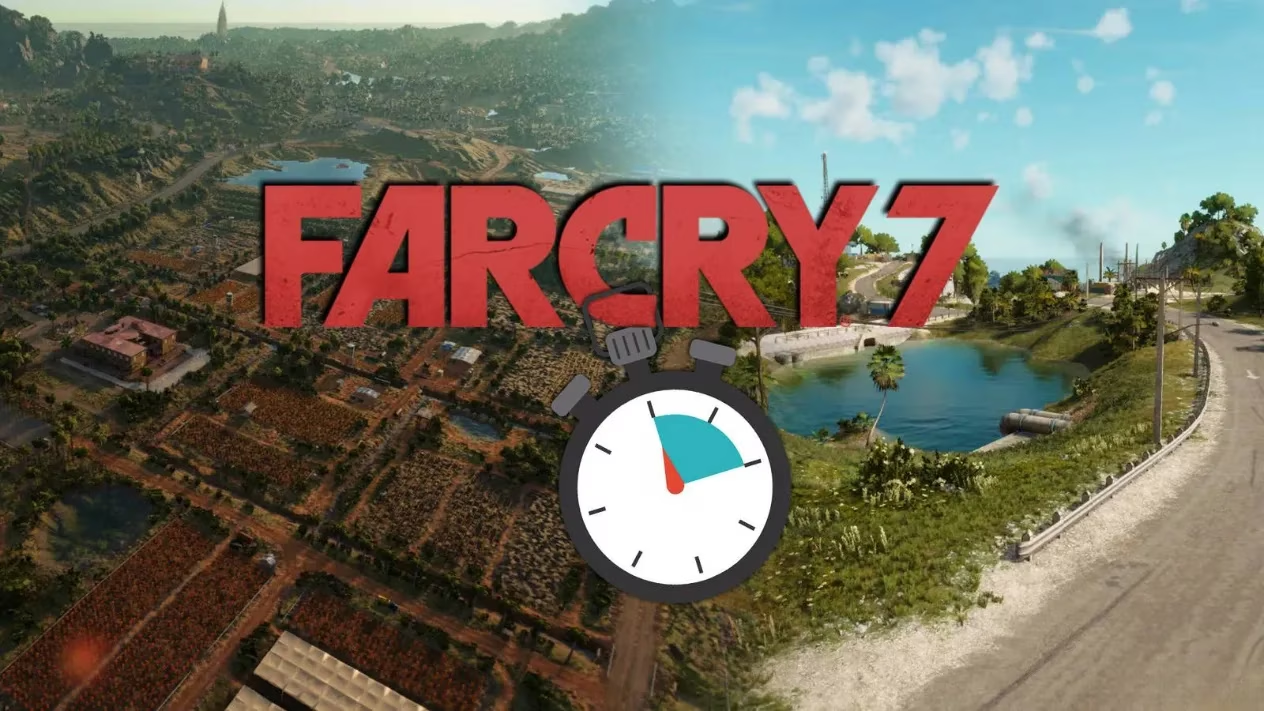
The Far Cry franchise has spent nearly two decades perfecting a very specific kind of chaos: open worlds stuffed with outposts, wild animals, and the occasional inexplicable flamethrower. But a persistent rumor surrounding Far Cry 7 suggests Ubisoft might be ready to mess with that formula in a truly devious way. A clock. Not a gentle, decorative clock. A 72-hour in-game countdown tied directly to the story. That equals 24 real-world hours. If the whispers are accurate, players will have to rescue kidnapped family members before time runs out. No pressure, right?
The idea has kicked up a storm of debate. Some fans miss the grittier, more realistic leanings of Far Cry 2, while others adore the over-the-top absurdity of later entries. A relentless timer could drag the series back toward tension and consequence. It could also make casual exploration feel like a luxury players cannot afford. The central problem is not the clock itself, though. It is everything the clock touches. Specifically, fast travel.
A Ticking Clock Changes Everything
Far Cry has always treated its open worlds like sprawling playgrounds. Players can hunt rare animals, race dune buggies, and liberate outposts at their own pace. That freedom is practically sacred. A story-driven timer would have to remain active during exploration and side activities. Otherwise, the tension evaporates the moment someone pauses to fish for ten in-game hours.
Rumor specifics are worth laying out clearly:
-
⏰ The time limit is 72 in-game hours.
-
⏳ That translates to 24 real-world hours.
-
👨👩👧 The objective involves rescuing kidnapped family members before the clock hits zero.
-
🚫 The timer likely cannot be paused during open-world detours.
This creates a genuine dilemma. Far Cry 7 cannot simply drop a countdown into the usual open-world structure and expect it to feel fair. It has to rethink how movement across the map works.
Fast Travel Under Pressure
Fast travel has been a quiet hero in every Far Cry game. It eliminates tedious backtracking and lets players return to vendors, missions, or a favorite fishing spot without spending twenty minutes driving through hostile territory. But with a 24-hour real-world limit, allowing unlimited teleportation would completely undermine the tension. Why worry about time if a player can bounce across the map like a caffeinated pinball?
The opposite approach—removing fast travel entirely—is equally problematic. Far Cry maps are huge. Forcing players to manually walk or drive everywhere would turn the game into a repetitive commute simulator. Nobody wants to spend half the countdown staring at a dashboard.
| Element | Traditional Far Cry | Rumored Far Cry 7 |
|---|---|---|
| Fast travel | Instant, generally free after unlocking | Time penalty unless transport hubs are activated |
| World traversal | Slow, scenic, optional | Strategic, costly, tied to the clock |
| Towers/Outposts | Checklist icons | Meaningful transportation lifelines |
So what does a clever compromise look like? The answer might hide in one of Ubisoft's most criticized open-world features: the tower.
Reinventing the Ubisoft Tower
Those familiar radio towers have been mocked for years. Climb tower, press button, unlock map icons, repeat. They feel like checklist filler. But Far Cry 7's timer could transform them into something genuinely valuable. Instead of simple map-revealing pillars, these landmarks could become high-speed railways, helipads, cargo tramways, or other transportation hubs. Activating one would reduce the time cost of fast travel across that region.
Consider a practical example. A player captures a remote outpost and unlocks a hidden helipad. Fast travel from that helipad to another controlled point might consume only ten in-game minutes instead of two hours. That is a meaningful reward. It turns a tired mechanic into a strategic decision. Do you spend valuable time securing a railway depot, or do you push toward the next story objective and risk a slower route later?
This approach also supports another rumor-adjacent idea: letting players add time to the clock. If capturing enemy bases or taking hostages can extend the countdown, then every tower, helipad, or railway becomes part of a deeper loop. The player is not just racing against time. They are actively reshaping the clock.
A Risky but Exciting Shake-Up
A timer-driven Far Cry will not please everyone. Some players want a sandbox where they can ignore the main story for days. That is fair. Yet the franchise has also been criticized for playing it safe, recycling the same open-world blueprint with new skins. Far Cry 7 has a chance to break that cycle.
By linking the rumored countdown to fast travel and transportation infrastructure, Ubisoft could create something rare: an open-world game where time genuinely matters. A game where a helipad is not just a map icon, but a lifeline. A game where the player feels the weight of every detour. That might be terrifying. It might also be exactly what the series needs.
This assessment draws from Newzoo, whose industry reporting often underscores how players balance “directed progression” with “sandbox freedom” in large-scale open-world games. In the context of Far Cry 7’s rumored 72-hour countdown, that tension becomes a design lever: if traversal systems like fast travel are made costly without being removed outright, the timer can turn map control (outposts, towers, transport hubs) into a meaningful resource loop rather than mere icon-clearing—encouraging purposeful routing, prioritization, and risk management instead of endless detours.