In the sprawling, content-rich landscape of 2026, a former Bethesda luminary has voiced a compelling critique that's resonating across the industry. Will Shen, whose design legacy is etched into titans like Skyrim, Fallout 4, and Starfield, argues that the modern expectation for games to be colossal, 100+ hour commitments is leading to audience fatigue and diminishing returns. This isn't mere nostalgia talking; it's a seasoned developer's analysis of an industry trend that's hit its tipping point. Shen, during a recent appearance on the Kiwi Talkz podcast, suggested that the relentless drive for "evergreen" games players can sink "thousands of hours into" has created a paradox: while offering perceived value, it often prevents players from actually completing—and fully engaging with—a narrative experience.

The 'Evergreen' Legacy and Its Domino Effect
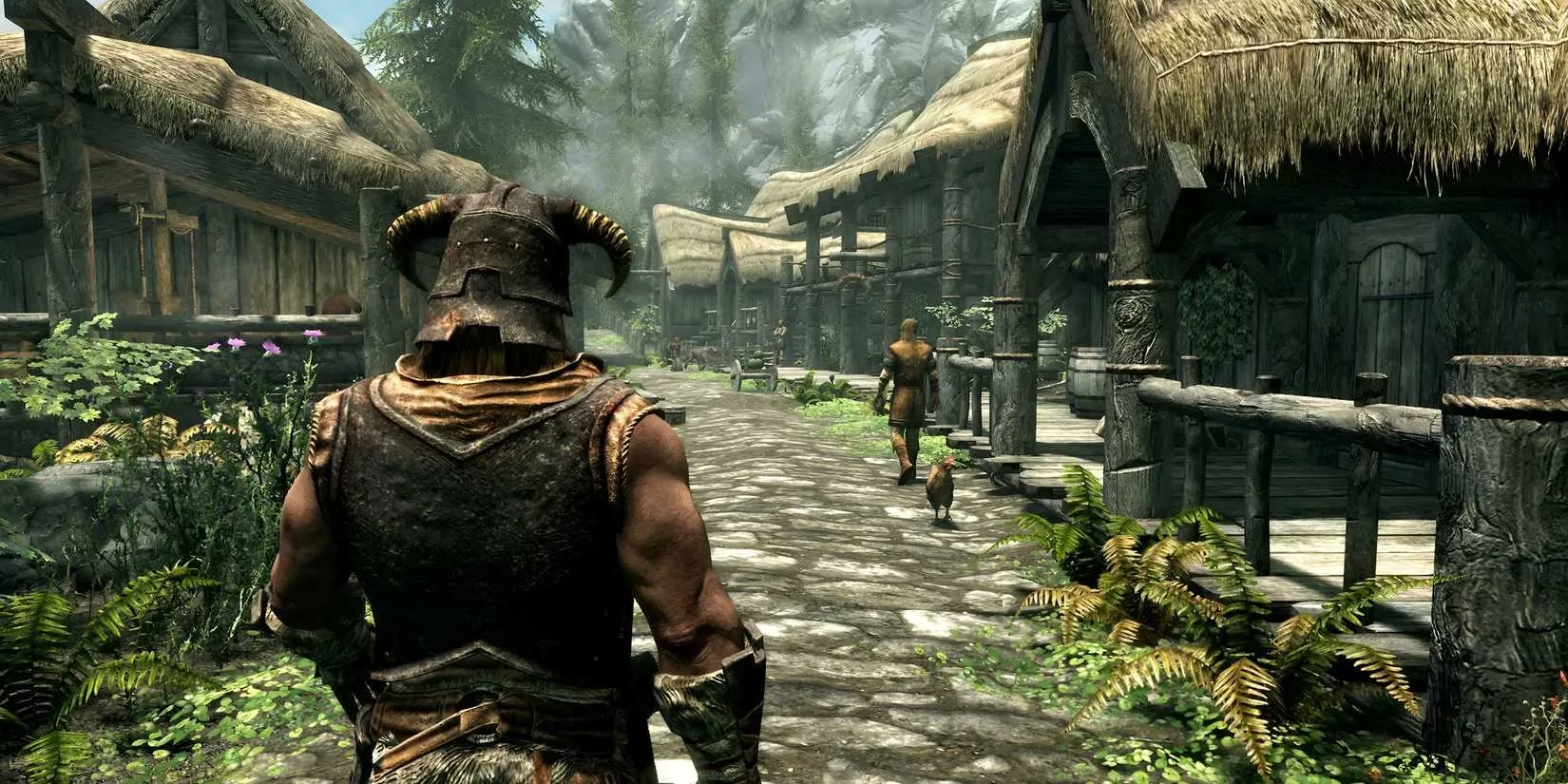
Shen traced the lineage of today's marathon gaming sessions back to the seismic successes of the early 2010s. "Part of what happened was the successes of games like Skyrim and Fallout 4, these really big titles that you can play pretty much forever," he noted. Before these open-world epics, the domain of infinite playtime belonged primarily to MMOs like World of Warcraft. However, Skyrim and its successors democratized that model, offering vast, single-player worlds that hit "the tipping point of you could kinda play this forever." This, Shen explained, became the new industry gold standard, a trend that has only intensified over the last decade and a half.
The fallout? A baked-in expectation that every major release must check a daunting list of boxes:
-
✅ Minimum 40+ hours of core content
-
✅ Deep, often grindy, progression systems
-
✅ Survival/Crafting mechanics (a direct influence from the Minecraft phenomenon)
"It's becoming accepted that games are too long today," Shen observed, highlighting a collective weariness. Gamers already have their cherished evergreen titles—their personal Skyrims or Animal Crossing islands—that they return to perpetually. Asking them to adopt another game with similar time demands is, in his words, "a tall order." It's a classic case of diminishing marginal utility; the 100th hour in a new RPG rarely delivers the same joy as the 10th.
The Indie Resurgence and the Power of Completion
In response to this saturation, Shen points to a vibrant counter-movement: the rise of shorter, tightly focused indie games. He cites the example of Mouthwashing, a critically acclaimed narrative game designed to be completed in about three hours. The magic, according to Shen, isn't just in the brevity, but in the shared completion rate. When nearly everyone who starts a game actually finishes it, something powerful happens for the community.
| Game Length Model | Player Completion Rate | Community Engagement |
|---|---|---|
| 100+ Hour Epic | Relatively Low | Fragmented; players discuss different, unfinished segments |
| 3-10 Hour Focused Experience | Exceptionally High | Unified; players share insights on a complete, common journey |
"Everyone experiences everything the game offers," Shen emphasized. This creates a fertile ground for rich discussion, deeper analysis, and a stronger, more connected player base. It’s the difference between a book club where only a few members have finished the novel versus one where everyone has. In an age where social media and shared cultural moments are key, this completeness is a superpower. Shorter games cut through the noise and offer a satisfying, whole package—a concept that feels almost radical in 2026.
Looking Ahead: A Market Correction?
Shen's commentary arrives at a potential inflection point. The astronomical budgets and development cycles for blockbuster "forever games" are increasingly unsustainable, and player backlogs are more intimidating than ever. The industry may be primed for a market correction, embracing a broader spectrum of experiences.
The future likely isn't an either/or scenario but a 'yes, and' approach. There will always be a place for vast, sprawling worlds (Bethesda's own The Elder Scrolls VI is undoubtedly one of them). However, Shen's insight validates a growing space for premium, shorter titles that respect the player's time. Think of it as the difference between committing to a multi-season TV series versus being profoundly moved by a perfectly crafted film. Both have immense value, but the latter has been undervalued in gaming's mainstream for too long.
Ultimately, Shen's argument is a plea for intentionality. It's not that long games are bad; it's that length should serve the experience, not just the marketing bullet points on the back of the box. As we move further into the decade, the most memorable games might not be the ones we live in for months, but the ones we truly finish and carry with us. That's a paradigm shift worth playing for. 🎮✨